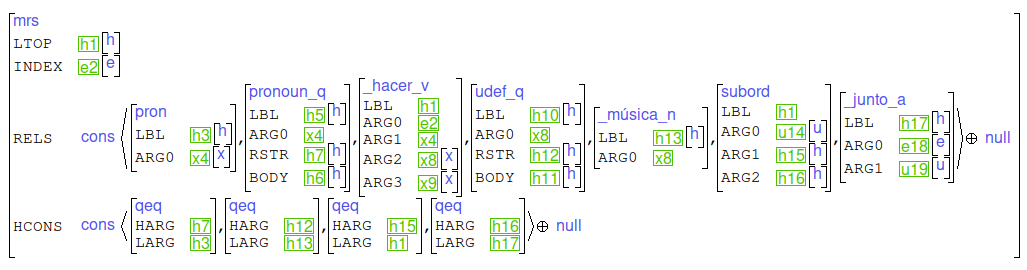
There is a subordination relation which I suppose is OK, and then the modifier is linked to the event but, unlike the ERG, not through the ARG1. Furthermore, there is no connection to the pronoun.
Should I consider some changes in both these respects?
Why should it be reflected in the MRS at all? Isn’t the agreement here only syntactic?
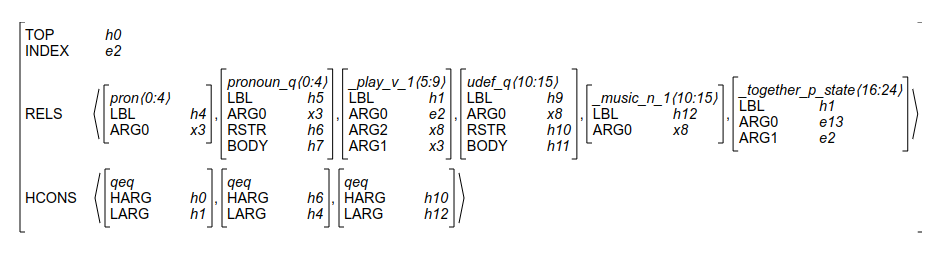
The shape of the ERG parse is different also because the _together_p_state EP is not the same category as _junto_a and does not require the same methods of connection. Here is the MRS from a similar ERG parse for They play music united, which is not a very fluent translation, but its structure may be enlightening:
This looks very similar to the Spanish one except for three things (the last two are unrelated to the current question and I think they reflect bugs in the grammar):
The ARG1 of _junto_a uses a u variable instead of an i one for the unlinked argument.
_hacer_v has an ARG3 with the value x9 but x9 does not appear anywhere else. If it is an unfilled argument, I would expect an i9 instead.)
The (L)TOP is directly linked to the label of the highest EP in the Spanish MRS, but the ERG more conventionally goes through a qeq: h0 qeq h1
If you want junto_a to link to the pron EP, then you might be saying that juntos is a property of Ellos instead of a manner of hacen música. In the ERG, you can get a parse like this with, e.g., United people play music or They together play music.