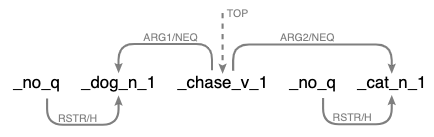
I am currently exploring the translation of MRS logical form (scope-specified) to first-order logic expression. In particular, I am not sure how to translate negative quantifiers. For example, consider the sentence
The translation of no to first-order expression should be:
no(x, R(x), B(x)) → ∀x R(x) ⇒ ¬B(x)
So, the first-order translation of the sentence would be:
∀d dog(d) ⇒ ¬[∀c cat(c) ⇒ ¬chase (e, d, c)], which simplifies to:
∀d dog(d) ⇒ ∃c cat(c) ∧ chase (e, d, c)
This translation makes sense to me. However, a similar analysis does not seem to make sense when I consider the sentence
So, the first-order translation of the sentence would be:
∀d dog(d) ⇒ ¬[∀c cat(c) ⇒ ¬(chase (e, d, c) ∧ bark(d))], which simplifies to:
∀d dog(d) ⇒ [∃c cat(c) ∧ chase (e, d, c) ∧ bark(d)]
This first-order expression says that the dog barks anyway, which is not what the original sentence asserts.
I also notice a similar thread but it does not seem to answer the question here. I think the sentences I provided here are ‘simple’ enough for a complete translation to first-order logic expression. Does anyone know where did things go wrong? Many thanks!
What the original sentence asserts depends on which scope reading you think the sentence should have.
I suspect you want “bark” to be outside the scope of “no(c)”. To allow this, “and” needs its own position in the scope tree, with its two children being QEQ to “chase” and “bark”. Then “no(c)” can appear between “and” and “chase”.
Thanks, this is an interesting example! Covering all kinds of coordination is actually very difficult, and you shouldn’t consider it a solved problem. There is plenty of discussion in the wiki, if you dare to look, e.g. VirtualCoordinationComposition · delph-in/docs Wiki · GitHub
Should we consider the scope tree I provided for No dogs chase no cats and bark. an extra scope reading that the MRS allows but in fact an invalid one, or is it actually that the translation itself from the MRS meta-language to first-order logic as the object language is problematic? Personally I could not understand such a reading which asserts all dogs do bark from the sentence.
Trying to understand all the possible scopes of a sentence can be a fun but time-consuming game. Having played this game many times, I can suggest doing the following:
Simplify the sentence to isolate the confusing part.
Modify the sentence to make the intended scope more reasonable (or make other scopes less reasonable).
Come up with a discourse which supports the intended scope.
So, firstly, the confusing part is having a quantifier in one part of the coordination which scopes over the whole coordination. We can get rid of the first “no”, as in the example below. In the reading where the remaining “no” scopes over “bark”, Fido did not bark.
Fido chased no cats and barked.
Secondly, how do we make this reading more reasonable? Well, if “no” takes wide scope, the chasing and barking events are coordinated together at the bottom of the scope tree, so we have a kind of combined event which “no” takes scope over. So we could suggest this, as in the example below.
Fido chased no cats and barked at the same time.
But if Fido isn’t chasing cats, why do we care about barking? So, thirdly, we can build a discourse context:
My dog Fido likes to chase cats, but I really wish Fido would bark at the same time, so that I know what’s happening. Just this morning, Fido chased three cats, but I had no idea, because Fido chased no cats and barked at the same time.
You might still think it sounds a bit unnatural, but hopefully you can see what the scope is supposed to be. If you want to find a better example, you could also go back to step 2 and try with other words where there is a more obvious connection between the two events, e.g.:
Kim passed no exams and got a certificate to show it.
I am dealing with related question and maybe I will only paraphrase the problem already presented above. Consider the sentences below in a context of RTE (text entailment) task:
A man is walking
A man is not walking
No man is walking
What pairs should be CONTRADICTORY? 1-3 is clear to me considering a situation like a picture being described. Either we have a man doing the action of walk OR we can’t see any man doing the action of walk. The pair 1-2 is more controversial. I can imagine a picture with a man walking AND another man not walking but doing another thing.
So how to make a FOL representation from the ERG produced MRSs:
Case 1: the only detail that I learned is that the existential quantifier need to be as deep as possible in the formula, closer to the predicate wich has it as ARG0. It does not make different here (F1a equivallent to F1b), but it will make in the next formulas. Thanks to Johan Bos to clarrify that.
Case 3: I got 3 analysis, two of them with the no analysed as ADV. I will ignore them. The first analysis is the expected one with no as determinant. From the scoped resolved tree, only one possible formula. Here the existential e2 can’t be introduced in the outmost scope, after all, the event of walk didn’t happen.
The different between the MRSs is only the INDEX, in both cases, there is no constraint on the relative position of h4 and h1. Keep in mind the rule to make the e quantification as close as possible to the predicate which have it as intrinsic variable:
F2a was hard to accepted but once we apply some De Morgan’s law
∀ x3, (¬ _man_n_1 x3 ∨ ∀ e2, ¬ _walk_v_1 e2 x3)
For sure this topic was already exhaustively discussed … so references are welcome. The main question is:
Is it true that e variables need to be always quantified as close as possible to the predication which has it as the intrinsic variable? Why papers like [1310.4938] A Logic-based Approach for Recognizing Textual Entailment Supported by Ontological Background Knowledge does not discuss how ‘e’ variables need to be quantified? What is the main reason for not add implicit quantification for the ‘e’ variables given that for ‘x’ variables implicit quantifications are added?
In terms of literal semantics, they are not contradictory. In terms of pragmatic implicature, they might be (particularly in the context of describing an image). This would be a special case of a “quantity implicature”, i.e. “a man” has the implicature “there is exactly one man”.
This matches how natural language is used. I tried searching for the history of this idea, and Champollion credits Parsons (1987):
I checked Davidson (1967) and I can’t see any discussion of scope there. I don’t know if Davidson discussed it later.
It’s completely deterministic to add event quantifiers with low scope. So adding them to the grammar would only be a notational change (there is a simple 1-to-1 correspondence between analyses with or without the event quantifiers). However, adding them would increase the size of the feature structures and slow down parsing.
The ERG has several different implicit quantifiers for instances. But the documentation also says “It is tempting to consider changing the three more specialized implicit quantifiers to just the one udef_q” (see: ErgSemantics_ImplicitQuantifiers · delph-in/docs Wiki · GitHub). If they were all collapsed into udef_q, then again it would be deterministic to remove/add them.
On the point about the ERG currently providing several specialized implicit quantifiers, would it be beneficial (for those of you consuming the MRS output) if the grammar collapsed those distinctions into the existing udef_q? Or perhaps we could go a step further and mark the definite/indefinite distinction with an additional attribute on indices, and have the quantifier simply be existential_q. Would this be an improvement, or would such a change introduce more problems than it would solve?
Hi @Dan, I don’t know. To answer that question, I guess we must understand the motivation for each implicit quantifier from ERG. Do we have documentation about them?
I know almost nothing about pragmatics. Just some general understanding from the yet partial reading of Emily’s book. Reading Wikipedia, I found only this tiny section about the formalization of pragmatics. I am working on the SICK dataset pushing the limits of MRS to FOL (as starting point), I wonder if someone seriously considers pragmatics when solving RTE datasets. References will be welcome.
I am still in the preliminary work of adapting the MRS to FOL transformation, and I am still unable to confirm if adding the quantifiers of ‘e’ variables will be deterministic. Eventually, complications can arise in the presence of modalities, compounds, nominalizations, coordination etc.
This is not directly related to negation since in the paraphrases such as:
A man is running
There is a man running
They would not be considered (as expected) entailment. So maybe I must consider some transformations of possible paraphrases before translating them to logic. Any reference in the literature?
Could you just treat _be_v_there as always true? Then the propositions can be simplified. It would work for these examples, but maybe there are more complicated examples I haven’t thought of.
Not a bad idea @guyemerson!! I am trying it. At least for some cases, I experimented manually, it seems to work fine. For the positive case, the second reading of “There is a man running” is the expected one: