In the Grammar Matrix, we currently have several append-list-valued features: REL, SLASH, QUE, and, most recently, YNQ (for second position clitics in polar questions).
I am trying to finalize some kind of (unified?) account of all these features in the filler-gap phrase (or perhaps just in the wh-question subtype of the filler-gap phrase).
Here’s the basic filler phrase in its current form. As you can see, the append lists are mostly underspecified:
basic-filler-phrase := binary-phrase & phrasal &
  [ SYNSEM [ LOCAL.CAT.VAL [ COMPS < >,
                             SPR < > ] ],
    ARGS < [ SYNSEM [ LOCAL local &
			    [ CAT.VAL [ SUBJ olist,
					COMPS olist,
					SPR olist ],
			      CTXT.ACTIVATED + ],
		      NON-LOCAL [ SLASH append-list, QUE append-list, REL 0-alist, YNQ append-list ] ] ],
	   [ SYNSEM [ LOCAL.CAT [ VAL.COMPS olist ],
		      NON-LOCAL [ SLASH append-list,
				  REL 0-alist,
				  QUE append-list, YNQ append-list ] ] ] > ].
The wh-question phrase operates on the SLASH list as follows:
1st-head-filler-phrase := basic-filler-phrase & head-compositional &
  [ SYNSEM.NON-LOCAL.SLASH.LIST #slash,
    ARGS < [ SYNSEM.LOCAL #local &
                          [ CAT.HEAD +nrpd ] ],
           [ SYNSEM.NON-LOCAL.SLASH.LIST < #local . #slash >   ] > ].
The question remains what to do with the rest of the lists, particularly QUE and YNQ, which, when non-empty, normally trigger the application of a unary rule. In the ERG, I think they would be zeroed-out on the mother, and this way if a filler-gap rule applied, an in-situ rule won’t apply, etc:
; DPF 21-jul-04 - Removed parent head_nexus_que_phrase since this didn't allow
; multiple-wh clauses like "who hired whom", and it wrongly implied that there
; would be filler-head constructions where the mother still had a non-empty
; QUE value.

head_filler_phrase := basic_head_filler_phrase & head_final & binary_phrase &
  [ SYNSEM [ LOCAL.CAT.VAL.SPR < >,
             NONLOC.QUE 0-dlist ],
    ARGS < [ SYNSEM.LOCAL.CAT.VAL.SPR *olist* ], sign > ].
For a while, this is what I’ve been doing as well for the Matrix wh-questions library and for my Russian development grammar in particular. It mostly seems to work, though I keep thinking: if we take out things from SLASH one by one, why aren’t we doing the same thing for QUE?
So, while zeroing QUE and YNQ mostly works out, I have a slight problem with sentences like (1):
(1) Кто     знает,   где   мы  что      видели?
    Kto     znaet,   gde   my  chto     videli?
    who.NOM know.3SG where 1PL what.ACC see.1PL
Who knows what we saw where? [rus]
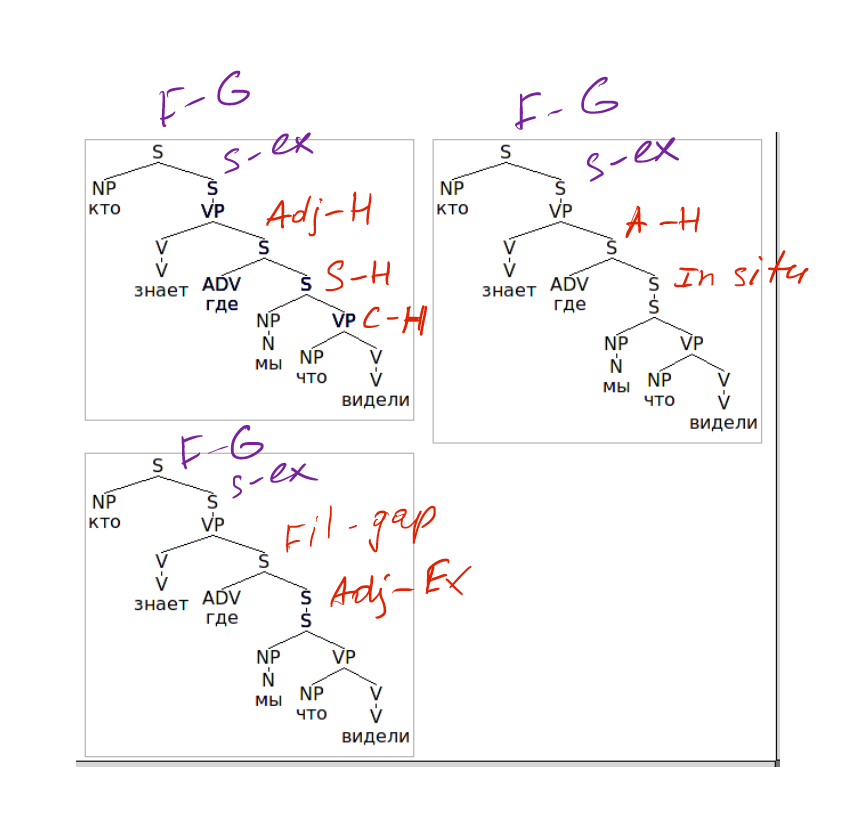
For this one, because the top node is licensed by a filler-gap rule (and the QUE list is zeroed out), I still get an additional tree with the in-situ phrase licensing the embedded we saw what:

Any thoughts on this? Again, this is an additional tree to the one where where/gde is extracted and gets attached by an filler-gap rule.
I am already using MODIFIED on the mother of the in-situ clause to block extracting adjuncts from it. The mother is also L-QUE -, so, disallows a wh-word in its left periphery. But none of this helps when the question is embedded: the wh-word is no longer in the left periphery, and a regular adjunct-head rule may apply to attach the wh-adverb, so the MODIFIED constraint no longer helps, either. Would it make any sense to constrain the normal head-adjunct rules for MODIFIED? Probably not, right, because of course there may be multiple adjuncts.
I cannot address this by constraining normal adj-head phrase to not take wh-words as adjuncts when the adjunct ends up left-peripheral because then I lose some coverage (such as Who knows we bought what where, in Russian, or even just Ivan HOW arrived?).
All in all, seems like there is a lot embedded in embedded questions…
 ).